Saturday, August 8, 2015

The Last Days of William Cook in the Press

Ad in The Winnipeg Tribune, January 16, 1908
Day of William Cook's Funeral
I recently started a free trial of Newspapers.com, which hadn’t been yielding very much about my direct ancestors until I switched from their U.S. section to the Canadian one. I was pleased to see that there were newspapers from the turn of the century from both Winnipeg and Vancouver covering some of the times when my Cooks lived there. I was ecstatic to find an obituary for my great great grandfather, William Cook, right of the bat. I despaired of every finding one. This is from the January 14, 1908 Winnipeg Tribune:


From the account of one of his daughters, he died at 1:20 a.m. According to the weather report in the same newspaper, the weather was “cloudy” that day, with “light snow fall” expected.

This was followed by an funeral notice in the Tribune January 16, 1908:


And an item following the funeral from the same paper on January 17th:


That the family lived in a boarding house gave them premises large enough to host a small funeral. (The two different addresses on Donald Street, 141 and 144, could mean that 141 was a misprint, or that the boarding comprised more than one address).I’m thinking that the “Rev. Mr. Parker” was likely of the Anglican Church, as William was Church of England. The weather report that day states it was “fair”, but that it had been “quite cold”. This might mean that the family was blessed with clear weather as they made their procession to the cemetery.

These notices add significantly to what I already knew. William’s death certificate listed “diabetes” as his cause of death, but gave his illness as “two days” duration. That he also died of “pneumonia” makes this make sense. I knew that the family had come to Winnipeg from Moosomin, Saskatchewan between 1906 and 1908, but did not know that they came in April 1907. I had discovered through Findagrave that he was buried in the Elmwood Cemetery in Winnipeg, but had had no information about his funeral. That it was held in his home two days after his death followed by the burial was new to me. I knew from Winnipeg city directories that William’s wife Emma had operated a boarding house at their address, 144 Donald Street, but had not known that William had been part of this during the last months of his life.

When I searched on their address, I was able to find the following advertisement in the January 3, 1908 Manitoba Morning Free Press, eleven days before William died:


Now we know that they considered their establishment to be “first class” and that they charged four dollars per week. From the 1906 Canada Census of Manitoba, Saskatchewan, and Alberta, we know that earlier in that year, the family was still living on their farm in their log cabin in Moosomin, with their hired man Charles, their horses, their one milk cow, their one sheep, and their thirteen pigs. The children still at home at that time were Samuel, Faith, Mary Eliza, and Godfrey. It seems from this and other data, that these were the four children living at home at the time of their father’s death. Samuel would have been have been twenty-one, Faith nineteen, Mary Eliza sixteen, and Godfrey twelve. (The same four children are living with their mother in Vancouver in 1911, along with their older brother Edward. Only Faith is married). From what I can gather, it may have been possible for all the other children, now adults, to attend the funeral, some having to travel from Saskatchewan, except for Lily, who was the first to move out to Vancouver.

With this level of detail, it is possible to imagine what this time must have been like for the family. It seems as though the loss of William must have come as a huge shock, despite his diabetes, as he had only been sick with pneumonia for two days.

I have put out a request on Findagrave for a photo of William's grave marker, which is located at plot 8-G0523, Elmwood Cemetery, 88 Hespeler Avenue, Winnipeg, Manitoba, but so far there have been no takers. If any of you gentle readers would be kind enough to provide me with such a photo, I promise to post it to Findagrave, and I will put the photo in a blogpost giving you full credit. A map of the cemetery can be found here: Elmwood Cemetery Map.

A "Tony" Bosomworth Wedding in 1881

The boyhood home of the groom, William Gelder Shepardson.
from History of Macoupin County Illinois: And Biographical Sketches of Some of its Prominent
Men and Pioneers,
accessed via Google Books


Among the Carlinville newspapers I found on the Old Fulton Post Cards website was a wedding announcement for my great grand aunt, Mary J. Bosomworth, also known as “Mollie”, who was the sister of my great grandmother, Anna Belle Bosomworth Marlow. She had married William Gelder Shepardson, who was the adopted son of Thomas S. Gelder, one of the early settlers of the area. Thomas Gelder, who was originally from Yorkshire, was a veteran of the Black Hawk War, during which he fought alongside Abraham Lincoln. (The Gelder homestead is depicted above). The wedding was held at the home of my great great grandparents, Charles and Ann Bosomworth on January 13, 1881, in Chesterfield, Illinois, according to the February 3, 1881 Carlinville Free Democrat. What is interesting about the article, is not only the detail it gives about the wedding, but also that it includes a list of most of the wedding gifts, and who gave them! I don’t think I have ever seen this included in a marriage announcement before. It may be a whole or partial list of the guests, but may also be a way of acknowledging people who sent gifts but who did not attend. Here is a transcript. I have added the relationship of the giver listed to the bride or groom where not explicit:


A Tony Wedding

Quite a number of guests assembled at the residence of Chas. Bosomworth Thursday eve., Jan. 13th to witness the marriage of his daughter Miss Mollie to Mr. W. G. Shepardson, Rev. March officiating. After the impressive ceremony was performed supper was served which was complete in every respect. The following is nearly a complete list of the presents received:

Pair of scissors, father of the bride.
Two brooms, mother of the bride.
Set of napkins, Allie Bosomworth.  [Alice, sister of the bride].
Set of plates, Irene Bosomworth.  [Sister of the bride].
Glass water pitcher, T. Shearburn. [Likely groom’s sister’s husband’s brother, Thomas A. Shearburn].
Set of goblets, Mrs. T. Shearburn. [Wife of groom’s sister’s husband’s brother].
Pair of vases, Mary Bosomworth.  [Likely cousin of bride, Mary Jane Bosomworth, daughter of George Robert Bosomworth, and born same year as the bride].
Pair of towels and coffee mill, Mr. and Mrs. N¬__.
Set of knives and forks, John Allen.
Lamp, Mr. and Mrs. T. Towse.
Set of napkins, Mr. and Mrs. S. L. Berryman.
Set of goblets, Enola Peebles.
The set, John Candler and Ida Towse. [John Candler was the likely the brother of the bride’s aunt, Sarah Candler Bosomworth].
Comb case, Annie Bosomworth. [Anna Belle Bosomworth, sister of the bride, and my great grandmother].
 Lamp, John and Lucy Forth.
Washboard, R. D. Smith.
Goblets, John Bramley.
Pair of salt stands, Mr. and Mrs. H. L. De__.
Castor set, Chas. Forth.
Butter dish and water pitcher, H. Stamm.
Box of matches, Jessie Bosomworth. [Sister of the bride].
Syrup pitcher, W. D. Forbes. Tin cup, Edgar N__.
Pair of towels, Mr. and Mrs. Birdsall.
Butter dish, Low. Thornton.
Towels, Lizzie Boatman.
Glass watcher pitcher, Jas. Candler [James Candler was the likely the brother of the bride’s aunt, Sarah Candler Bosomworth].
Two pickle dishes, Carrie Ulster.
Pickle dish, Annie Cook.
Broom, Lizzie Armstrong.
Silver butter knife, Eliza ___ckels.
Table linens and towels, Dr. Collins, pref. _____, Fred and Frank Towse.
Wash tub, John Armstrong.


I suppose it would be natural  considering all of the above, to wonder if the title of the piece is ironic. After all, the wedding was in the home of the local blacksmith, and the bride’s parents give the couple a pair of scissors and two brooms. What struck me as I did a bit more research, is that the groom’s adopted family does not seem to be represented well among the givers of gifts. Thomas Gelder seems to have been a well-to-do and prominent citizen of the county, and was still living at the time of the marriage.  It is not clear if William Gelder Shepardson benefitted financially in any way due to his connection with his adopted father. William went on to make a business out of digging wells. I have yet to find any further information on his biological father, George Shepardson, or his mother. The only thing I know about them is that George was from England, and William’s mother was Irish.

William and Mollie had at least five children:  Piercy Dickenson (named for Mollie’s uncle), Mary Louise, Charles Bosomworth (named for Mollie’s father), Edith, and Nellie Gladys. Mollie died in 1943, and William died in 1946.

I would be interested if any of my gentle readers can identify any of the other guests, and their relationship to the family if known. The Towse family figures into the Joseph Marlow story later, as he rents a Towse family farm.

Saturday, August 1, 2015

The Drowning of George Arthur Smith, My Step Grandfather

One of the amazing items I found recently among the Carlinville newspapers in the Fulton Post Cards database was an obituary of my step grandfather, George Arthur Smith. He was the first husband of my grandmother, Lena Sarah Marlow, and the father of eight out of her nine children. My aunt, Roberta Smith Riddoch, recounts the story of the family in Verdant Valleys in and Around Lougheed, which is copyrighted, but fortunately available on line, where you can view a picture of Arthur and Lena with their first three children. Aunt Roberta does not give details of her father’s drowning, but family stories indicate that it was the most traumatic event any of them ever experienced. Unfortunately, it was one event in a string of tragedies: the untimely losses of Lena’s sisters Winnnie and Dollie, and Dollie’s daughter Ruby Belle, the death of her father Joseph to cancer, the fire which burned down Lena’s house after her husband’s death, a destructive hailstorm in July of 1930, and the subsequent suicide of her next husband, George Leslie Hart, to whom she had only been married for six weeks. Of course, all of this took place in the lead up to and onset of the Great Depression.

Arthur’s obituary, which appeared in The Carlinville Democrat on May 20, 1928, was one of a series of obituaries and letters home written by the Marlow family to their previous hometown newspaper, which were my great fortune to discover in the Fulton Post Cards historical newspapers database. This database contains mainly New York newspapers, and very few from other places, but includes five newspapers from Carlinville, Macoupin county, Illinois, the home of many of my Marlows and Bosomworths. The following obituary confirms the stories told to me by my cousins:

OBITUARY

George Arthur Smith, living on the J. W. Pfouts place, at Hardisty, Alberta, Canada, was accidentally drowned while out on the lake on a boat near his house. The boat took water and started to sink.Mr. Smith jumped from the boat and attempted to swim to shore. The water was deep and ice cold and he was a long ways out. He was attacked with cramps and was drowned. His eldest son, Glenn, tried to help him but had to turn back as the water was too deep. Mr. Smith was drowned before the eyes of his wife and children. The body was found at about 4 o'clock Tuesday morning May 15th. The accident occurred Monday evening about 8 o'clock, May 14th.

Mr. Smith was born April 18, 1892 near Chesterfield, Macoupin co., Ill. He grew to manhood in and near Chesterfield and Medora. He joined the Harmony Baptist Church when a boy. He was married to Lena Sarah Marlow, daughter of Mrs. J. H. Marlow, Feb. 20, 1912. Eight children were born to this union, six boys and two girls, namely: Glenn Marlow, Joseph Vernon, Wilbur Arthur, Roberta Annabelle, Dorothy Elizabeth, Byron William, Elwood George, and Ralph Fredrick. In the fall of 1913, he came to Lougheed, Alberta, Canada, stayed six months, and February 15, 1914, started back to Medora. He stayed there six years, and Sept 28, 1919 removed to Hardisty, Alberta, Canada, where he resided until his death. He leaves to mourn his death, his widow and eight children, the eldest being 15 years and the youngest 14 months, all at home. His mother, four half brothers, living in Illinois, besides many other relatives and friends.

The funeral was held in the English church at Lougheed, May 16th, conducted by Rev. Arthur Murphy of Hardisty. Burial was in the Lougheed cemetery. The services were attended by many relatives, neighbors and friends and there were many beautiful flowers. The pallbearers were Jim Hays, Frank Curtis, Leigh Kelsey, Hamlin Cooper, Percy Cooper and Robert Johnson.


Monday, July 27, 2015

Constable Joseph Henry Marlow: The Paper Trail

from Carlinville Democrat April 2, 1909. (Fulton Post Cards).

It has been a long while since I posted about my Great Grandfather, Joseph H. Marlow. I did have quite a number of documents early on, and now I have even more. Over the course of time I have sent for vital records from England, Illinois, and Alberta, and have found land records on line. But the most exciting event has happened in the last week. I stumbled on the fact that the Fulton Post Cards Newspapers data base, which contains mainly New York historical newspapers, and which I have used extensively in the past for my New York lines, also has five Carlinville, Illinois newspapers! I keep discovering more and more articles pertaining to the family of Joseph and Anna Belle Marlow. All of these documents and newspaper articles are attached to my tree on Ancestry. All of the Carlinville newspaper articles can also be found on the Fulton Post Cards website. So, to update you about my findings:

--From his parents’ marriage record and Joseph’s birth record, it appears that they married only one month prior to his birth. His parents, William Marlow (Marley) and Elizabeth Johnson were married on July 10, 1853 in the parish church at Whitby, North Yorkshire, (it was the first marriage for both), and Joseph was born on August 16, 1853 in Stainsacre.

--He did homestead in Nebraska, and on land that he purchased. His farm was in Benkelman, Dundy, Nebraska. He was living there at the time of his marriage to Anna Belle Bosomworth on November 30, 1887, by the Justice of the Peace in Modesto, Macoupin, Illinois, where the bride was residing. The marriage licence states that he is thirty, but he is actually thirty-four, fourteen years older than his twenty-year-old wife, rather than ten. Her brother-in-law, Benjamin Franklin Gracey (husband of her sister, Alice), and her sister-in-law, Hannah Bosomworth (wife of her brother Hartas), were the witnesses.

--All of their children were born in Illinois, including the eldest, Lena Sarah, my grandmother, on October 9, 1889, but the Nebraska land purchase was final on May 27, 1890. They may have been living in Nebraska still at the time of Lena’s birth, as she was born in Lynnville, Morgan, Illinois, where there is no other evidence Joseph and Anna Belle ever lived. Lynnville was the home of Anna Belle’s uncle, Piercy Dickenson, brother of her mother, Ann. The the Joseph Marlow family moved to Macoupin County in 1894. It may be that family lived in Chesterfield, Illinois, before living in Polk, Illinois, where Joseph rented a farm from the Towse family from at least the year 1900.

--In April 1909, he ran for one of two seats as Polk Town Constable, and won one of the seats, securing the second highest number of votes. He ran as a Democrat.

--In January 1910, he hosted an “Oyster Supper” at his home in Polk.

--On May 17, 1911, fire destroyed his barn, much of his farm equipment, and some hay and corn. Only some ploughs he was using were spared. Luckily, he was insured for his property.

--His daughter, Lena Sarah, married George Arthur Smith at the St. Paul’s Episcopal Church in Carlinville. It was the first marriage for both. Arthur required his mother’s consent due to being under age. (He was twenty, and she was twenty-two).

--It may be that the fire was an impetus for Joseph to emigrate to Canada, because in the summer of 1912, he and some other men travelled to the prairies. These other men were Joseph Wheeler, Charles Nichols, and Frank Leach. Joseph and Frank each bought a half section of land for twenty dollars an acre, located “twelve miles from a railroad”. He returned home in August.

--On Thursday, September 26, 1912, he held a sale at his farm, eight miles southwest of Carlinville, and four miles west of Chesterfield.

--In mid October, he left for Lougheed, Alberta with a train car load of his belongings. The newspapers do not state that his son Tom went with him as is claimed in family lore.

--Anna Belle and most of the rest of the children left Carlinville for Alberta on November 5, 1912. Daughter, Lena, recently married, and daughter, Winnie, stayed behind. Only Anna Belle, George, William, Maude, Dollie, Zella and Fred are on the border crossing record for November 7, 1912.

--Lena and Arthur Smith, Lena’s sister Winnie, and Eric Corney, left for Canada in August of 1913. Lena and Arthur planned to live there. A William Thompson, who lived in Chesterfield as did Winnie and Eric, also planned to go with them, but it does not appear that he went.

--Lena and Arthur returned home in February of 1914, and had planned to bring Winnie with them: “Miss Winnie Marlow, a sister of Mrs. Smith, expected to return with them and had made arrangements to meet them at a certain station in Canada, but when they boarded the train she failed to make an appearance, and as nothing had been heard from her considerable anxiety is felt in regard to her safety”.

--Winnie, who was the closest sibling in age to Lena, died in Lougheed on April 18, 1914 at the age of twenty-two of “typhoid”.

--A letter from Joseph was published in the Carlinville Democrat on Dec 29, 1915, renewing his 
subscription to the paper. He states, “We cannot get along without the Democrat”. He tells about bumper crops and fine winter weather. He also says, “The war does not affect us any; the only difference is all the young fellows have joined the colors”. There is no mention of the hardships they have endured, or of the loss of his daughter.

--On January 23, 1919, his daughter, Dollie Belle, died of influenza giving birth to her second child, Arnold Klinger. Like her sister Winnie, she also died at the age of twenty-two. A full obituary was  published in the Carlinville Democrat in February of 1919.

--Lena, Arthur, and family moved back to Alberta in September of 1919.

--On May 14, 1923, Joseph and Anna Belle legally adopted their daughter Dollie’s two children, Ruby Belle and Arnold.

--Another letter from Joseph was published in the Carlinville Democrat on January 28, 1925. He reports that he has not had a good crop that year, but that they are all in good health and that the weather is fine. He is again renewing his subscription to the newspaper, which he now appears to have kept up since moving to Alberta thirteen years before. He states that they are “now all alone on the farm”, as two of their sons are married, and have their own farms, and two have moved to United States near Seattle. The two sons with farms would be Joseph Robert “Tom”, and William. George and Fred “Fritz” went to the U.S. Daughters Lena and Maude are married with their own families, and Zella would likely still have been living at home since she was around fourteen at the time of the writing of the letter.

--Joseph died at home on June 7, 1927 of skin cancer on his face. His son Fred was back living with the family at this time. A long obituary was published in the Carlinville Democrat on July 13th. It confirms some of the family stories, such as the farm in Nebraska, and that he was a “sailor boy” at one time in his life. This long obituary contrasts with one published in Sedgewick, Alberta in the Sedgewick Sentinel, which is short and refers to him as “James H. Marlow”. His death registration is the first document I have found which gives his full middle name, “Henry”.

--In July of 1927, Annabelle, Zella and Fred drove to Illinois to visit relatives.


Monday, April 13, 2015

Faith Cook Saunders (1888 - 1974) Grave Site

Faith Saunders Gravestone
Ocean View Burial Park
Burnaby, BC Canada

It has been a long time since I blogged, but I hope to make up for this soon. I visited the Ocean View Burial Park recently, where I found Faith's grave site with the assistance of the very helpful cemetery staff. I also found her sister Mary Eliza Foster's grave, and her mother Emma Cook's grave, but Emma's had no visible headstone. I was told that it was possible that it had been overgrown, and that a work crew would look to see if there was one beneath the grass. I have a feeling that they will find one since Emma died so long ago (1930), and since I have yet to discover a family member who died locally and did not have a grave marker. I also created a Find A Grave Memorial for Faith.


Faith Cook Saunders (1888 - 1974) - Find A Grave Memorial

Friday, May 9, 2014

William Cook’s Brothers In Halton and Peoria: Elijah and Alfred

William Cook
I have written before that William Cook, my great great grandfather who homesteaded in Saskatchewan, came to Canada from England with his brother Elijah. I noted that I had found the brothers and their families in Halton, Ontario in the late 1880’s and early 1890’s. I also reported that I could find no trace of Elijah, his wife Charlotte (nee Bemrose) and their son William after that. Well, things have changed.

Due to a process of one piece of information leading to another, I have made some significant discoveries about William’s siblings. I had started looking into William and his family again due to the popularity of my blogposts about him, and because I wanted to provide more to my readers who want to know about the Cooks. (The responses I get from readers influence what I write about to a great extent). I discovered that another brother, Alfred Cook, also came to Canada with William and Elijah. (All of their father’s sons were therefore immigrants to North America). I was able to find Alfred living in Peoria, Illinois, starting in about 1896, and this led to my finding Elijah living there as well, and to discovering that Elijah also had a daughter.

Elijah Cook was born in 1858, the sixth of nine children, in Timberland, Lincolnshire, England, to William Cook Senior his wife Ann Squires. He married Charlotte Hannah Bemrose in Clee, Lincolnshire in 1883. Their son, William Alfred Cook, was born on March 27, 1885 in Lincoln, Lincolnshire. Elijah and his brothers William and Alfred came to Ontario, Canada in about 1888, very likely together. In the case of William and Elijah, their wives and children came separately at later dates. Elijah and Charlotte had a second child, Mary Ellen Priscilla Cook, on June 24, 1891 in Halton, Ontario. This birth is last record I have of Charlotte, and due to the records I have for the rest of the family, I suspect that she died in less than a decade after, and possibly in childbirth. The 1891 Canadian census shows Elijah living in Halton and working in a “brick yard”. He appears next in Peoria, Illinois, in the city directory, in 1895, as a “brick burner” for the “Peoria Brick” Company. Elijah and his brother Alfred then both appear in the 1896 Peoria City Directory, both working for the Peoria Brick Company, Elijah as a “foreman”, and Alfred as a “machine man”. It appears then, that Elijah may have come to Peoria first, to be followed by Alfred within the year.

Elijah appears in the Peoria city directory for the last time in 1900, and does not appear in the U.S. census for that year. His nine-year-old daughter Mary Ellen is found boarding with a family without her parents in Peoria in 1900. (There is a William Cook also boarding there, but he seems to be too old to be her brother William, but could be him with an incorrect age and place of birth). Because of this, and because the 1900 Peoria city directory is the last trace I have of Elijah, I believe he may have died in early 1900. His son William appears in the Peoria city directory from 1902 to 1906. In 1902 and 1903 he is working at the Kingman Plough Company, where his uncle Alfred is also working. Suddenly we next find William getting married in Monterey, California on May 27, 1906 to Angela Maria Serrano. They appear to have had only one son, William P. Cook, born August 23, 1909. William Alfred continued to live in the Monterey area for the rest of his life, mostly as a farmer, until his death on March 29, 1974 in San Francisco. As for his sister, Mary Ellen Priscilla, the next and only other record I have for her shows her marrying Ralph Alvan Wheeler in Monterey on May 18, 1918.  He dies November 4th of the same year.

William and Elijah’s brother Alfred was born about 1860 in Timberland, Lincolnshire. He was baptized August 5, 1860 at St. Andrew’s Church. He married Margaret Lancelotte in 1885 in Salford, Lancashire. Their first child, Frances Ancel Cook, was born in Pendlebury, Lancashire on August 31, 1885. Their son, and the only other child of theirs we know of to be born in England, William Jack, was born in Timberland on February 9, 1887. Their children born in Canada were Martha E. (born September 20, 1888) and Florence Mary, born about 1892. George Alfred Cook was born March 13, 1894 in Kirkville, New York, and Margaret was born in May 1896 in Peoria. Aflred and Margaret therefore had children born in three different countries. Alfred worked in a variety of occupations during his life, but in North America he primarily was a labourer in brick yards early on, and then a labourer for the Kingman Plough Company in Peoria for most of the rest of his life. It appears that Alfred was the only one of the brothers to return to England to visit, and it appears that he did this twice. His daughter Martha, although born in Canada in 1888, was baptized in Timberland at the age of five on August 20, 1894. This was two years before his father’s death. Alfred and Margaret also travelled to England on in 1909, as there is a record of them returning home to the United States on the Maurtenia on August 20, 1909. He lists his occupation as “blacksmith”, likely due to his having been an ironworks worker in 1881 in Gainsborough, Lincolnshire with his brother Elijah. Alfred died on July 29, 1926 in Peoria, where he had always lived after 1895. His wife Margaret died on March 22, 1935, also in Peoria.

Their son, George Alfred Cook, had a son William Alfred Cook, who became a multi-billionaire, and one of the richest men in America. I hope to write about them next.


Sunday, May 4, 2014

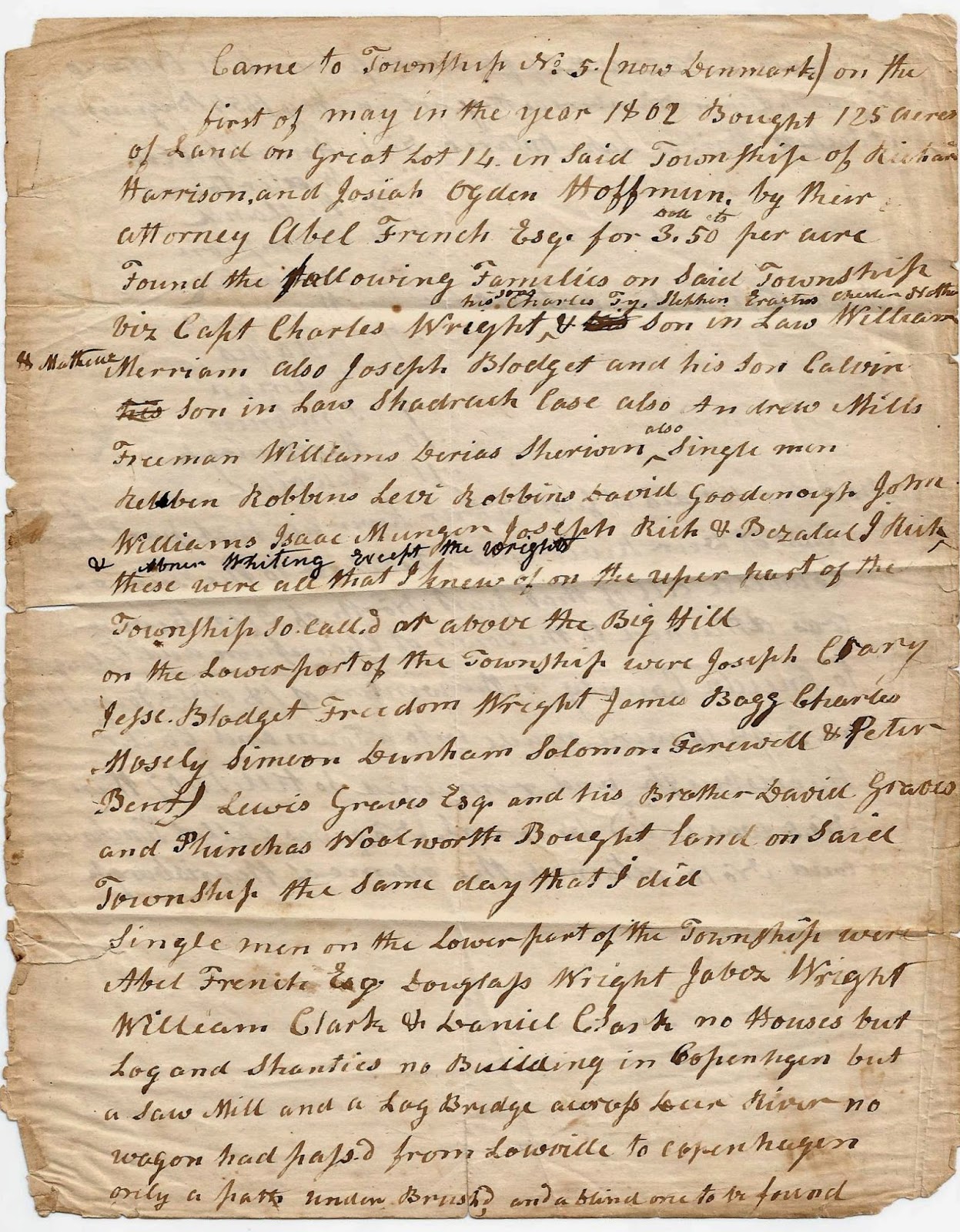
An 1853 Account of Wrights and Merriams in Denmark, Lewis County, New York

1853 Denmark Document Page One
Courtesy of Bob Tate

1853 Denmark Document Page Two
Courtesy of Bob Tate

One of my readers, Bob Tate, was kind and generous enough to have sent me a document, written in 1853, describing the early days of the town of Denmark in Lewis County, New York, at the turn of the nineteenth century. I don’t think I have ever touched paper so old. I don’t know who the author is, but there are clues enough in the document to identify him if he is included in the area land records. One of the exciting aspects of the piece is that it mentions my four times great grandfather, Charles Wright, his children, and his brother Freedom. It also mentions my three times great grandfather, William Merriam.

I present here a transcription of the document, to which I have added punctuation: Thank you so much, Bob.

Came to Township No. 5 (now Denmark) on the first of May in the year 1802. Bought 125 acres of land on Great Lot 14 in said Township of Richard Harrison and Josiah Ogden Hoffman, by their attorney Abel French Esq. for 3.50 per acre. Found the following families on said township vis. Capt Charles Wright, his sons Charles, Ty, Stephen, Erastus, Chester, Matthew, and son-in-law William Merriam, also Joseph Blodget and his son Calvin, son in law Shadrach Case also Andrew Mills, Freeman Williams, Darias Sherwin also single men Reuben Robbins, Levi Robbins, David Goodenough, John Williams, Isaac Mungen, Joseph Rich and Beralal J. Rich and Abner Whiting except the Wrights. These were all that I knew of on the upper part of the township so-called at above the Big Hill. On the lower part of the township were Joseph Crary, Jesse Blodget, Freedom Wright, James Bagg, Charles Mosely, Simeon Dunham, Solomon Berewell and Peter Beroff, Lewis Graves Esq. and his brother David Graves and Phinchas Woolworth. Bought land on said township the same day that I did.

Single men on the lower part of the township were Abel French Esq., Douglas Wright,  Jabez Wright, William Clark and Daniel Clark. No houses but log and shanties. No building in Copenhagen but a saw mill and a log bridge across Deer River. No wagon had passed from Lowville to Copenhagen only a path under brush and a blind one to be found.

The Township No. 5 was the fifth Township from Lake Ontario. Names of Eleven Numbers as they are in May 1854 beginning at Sackett Harbor Lake Ontario
                                                                                No. 1 Houndsfield
                                                                                No. 2 Watertown
                                                                                No. 3 Rutland
                                                                                No. 4 Champion
                                                                                No. 5 Denmark
Situated on Lake Ontario                              No. 6 Henderson
                                                                                No. 7 Adams
                                                                                No. 8 Rodman
                                                                                No. 9 Pinckney
                                                                                No.10 Harrisburgh
                                                                                No.11 Lowville

No. 5 was divided at first by Deer River all that part was situated east of Deer River ws attached to the town of Lowville all of that part North of Deer River was attached to the Town of Champion and belonged to Oneida Count in the winter of 1802 and three townships No. 5, 9 and 10 were made into a Town and called Harrisburgh and remained so till 1807 then No. 5 was called Denmark. No. 9 was called Pinckney and No. 10 retained the name of Harrisburgh.